
Beyond the Scalpel: A Technical Look at Why Knee Pain Doesn’t Always Mean Surgery
- Medwell Clinic

- Mar 19
- 3 min read
When chronic knee pain begins to interfere with simple tasks like walking or climbing stairs, many patients immediately fear the same thing: a total knee replacement. In the past, surgical intervention was often seen as the only "permanent" solution for joint degeneration. However, modern clinical evidence suggests that for many, Non-Surgical Knee Pain Relief is not only possible but medically preferable in the early-to-moderate stages of joint wear.
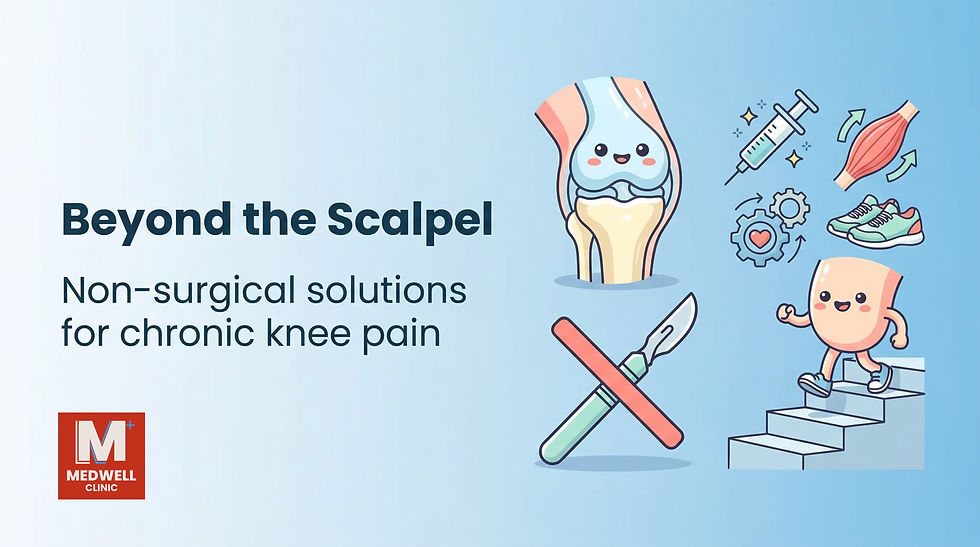
At Medwell Clinic, our Knee Injection Malaysia protocols are based on the latest understanding of joint physiology. This article explains the technical mechanisms of how we manage pain and support joint health without invasive surgery.
The Myth of the "Only Solution"
The belief that surgery is the only answer often stems from a misunderstanding of how joint pain works. Chronic pain is rarely just a "mechanical" issue; it is usually a combination of mechanical wear, chronic inflammation, and a loss of natural lubrication. While surgery replaces the mechanics, it is a significant physiological stressor.
Non-surgical clinical therapies aim to address the biochemical and mechanical environment of the knee joint simultaneously.

1. Modulation of Inflammation: Corticosteroids
When a joint is in a state of "flare-up," it is often due to an acute inflammatory response. This causes the synovial lining to thicken and produce excess fluid, leading to stiffness and sharp pain.
The Technical Process: A Corticosteroid Injection for Knee acts as a high-potency anti-inflammatory agent. By delivering the medication directly into the intra-articular space, it inhibits the production of inflammatory mediators (prostaglandins).
The Result: This leads to a rapid reduction in swelling and pain, providing a "window of opportunity" for patients to engage in physiotherapy to strengthen the supporting muscles of the knee.
2. Viscosupplementation: Hyaluronic Acid (HA)
In a healthy knee, synovial fluid (containing Hyaluronic Acid) acts as a lubricant and shock absorber. As we age or develop Osteoarthritis, this fluid loses its "viscoelastic" properties—meaning it becomes watery and fails to protect the cartilage.
The Technical Process: Hyaluronic Acid Injection Benefits come from "viscosupplementation." We inject a high-molecular-weight HA that mimics the body’s natural joint fluid.
The Result: This restores the "glide" within the joint. By reducing friction between the bones, HA injections help to minimise further mechanical wear on the remaining cartilage, supporting daily mobility and long-term comfort.
3. Biological Signalling: PRP Therapy
Platelet-Rich Plasma (PRP) is at the forefront of regenerative clinical wellness. Unlike medications that simply mask pain, PRP Therapy for Knee Pain utilises the body's own biological signalling to manage the joint environment.
The Technical Process: A small sample of the patient's blood is processed to isolate a high concentration of platelets. These platelets contain "Alpha Granules," which release hundreds of growth factors (such as TGF-beta and VEGF) when injected into the joint.
The Result: These growth factors do not "regrow" a new knee, but they do something equally vital: they signal the body to reduce chronic inflammation and support the environment for natural tissue repair. This makes it an essential tool in Osteoarthritis Treatment Ipoh.
When is Surgery Necessary?
It is important to remain balanced and factual. Surgery (such as Arthroplasty) is a highly effective and necessary intervention for "Grade 4" or "bone-on-bone" Osteoarthritis where the joint has lost its structural integrity.
However, clinical data shows that many patients classified in Grades 1 to 3 can significantly delay or even avoid the need for surgery by utilising a combination of:
Targeted Clinical Injections
Medical Weight Management (to reduce load on the joint)
Structured Physical Rehabilitation

The Medwell Approach: Evidence-Based Care
At Medwell Clinic, your journey begins with a comprehensive clinical assessment. We use medical history and physical examinations to determine the specific "drivers" of your pain. By matching the right injection therapy—whether it be HA for lubrication or PRP for biological support—we provide a personalised alternative to the surgical path.
Conclusion: Understanding Your Options
Choosing Non-Surgical Knee Pain Relief is about making an informed, evidence-based decision for your long-term health. By addressing the biological and mechanical health of your knee early, you can maintain your independence and activity levels without the downtime associated with major surgery.
Disclaimer: The information provided is for general educational purposes and is not a substitute for professional medical advice, diagnosis, or treatment. Results of non-surgical knee therapies can vary significantly between individuals based on the severity of their condition and overall health. Always consult with a qualified healthcare professional to discuss the most appropriate treatment plan for your specific needs.
Considering your non-surgical options?
Explore Our Knee Treatment Protocols or visit Medwell Clinic for a clinical evaluation.


Comments